
Birkas HaIlanos
1. Birkas Hailanos is recited when seeing a blossoming fruit tree. This is relevant only if one can see the buds (the white flower) from which the fruit will grow from.
2. Customs vary as to how many trees one should see in order to recite this Bracha. Some are of the opinion that one can say it when seeing two trees even of the same kind. Others contend that the two trees should be of different fruits.
Lehalacha, the Bracha can be recited when seeing even just one fruit tree.
3. Some are Mehader to recite the Bracha on the trees in fields or orchards. Lehalacha, the Bracha can be said on any tree including those that grow in the yard.
4. One can be lenient to recite the Bracha on a tree that grows in a flowerpot, as long as there is a hole in the base (עציץ נקוב).
5. The Bracha can be recited Lechatchila, even after the buds have fallen off and the fruits have started to grow, as long as the fruits are not yet edible.
6. If one did not recite the Bracha upon the first time seeing the buds on the tree, it can be recited when seeing it a second time, as long as there are still flowers blossoming. However, if the flowers have already fallen off and the fruits have started to grow, a Bracha cannot be recited.
7. The Bracha can be recited either during the day or at night, as long as the trees are clearly visible.
8. Strictly speaking, the Bracha can be recited on Shabbos and Yom Tov, however, some are stringent in the matter.
9. Although one can recite Birkas HaIlanos also during Adar or Iyar, Lechatchila it is recited during the month of Nissan.
10. Women also recite this Bracha (since it is not bound to a fixed time).
Places that need Bedikah
11. Bedikas Chametz must be done in all the places where Chametz could have been brought, even only occasionally.
12. A room that was cleaned still requires Bedikah, and on the night of Bedikas Chametz (the 14th of Nisan) it is difficult to check the entire house. Lechatchila, a practical solution would be that after cleaning each cupboard [within 30 days prior to Pesach], it should be checked with a candle (or a flashlight/torch) in all the corners. This will exempt him from checking it on the night of Bedikas Chametz (see below paragraphs 113 and 119 for more Dinim regarding Bedikas Chametz).
13. There is no obligation to get rid of pieces of Chametz smaller than a Kezayis if they are soiled [even just mildly and still fit for human consumption], Therefore one can spray some cleaning agent on crumbs of Chametz to soil them and there is no need to actually remove them.
14. Pieces of Chametz in cracks and crevices that are inaccessible, and similarly any Chametz that is accessible only by dismantling something, one is not required to trouble oneself to get to the Chametz to destroy it. It shares the same Halacha as Chametz that is under a pile of rubble.
15. Crumbs of Chametz on the floor that are trampled on ['Peirurim Hanidrosim'], do not require collecting and destroying. Therefore, there is no need to do Bedikas Chametz on the floor. Nevertheless, Chametz in the corners of the house which are not stepped on, should be sprayed with a cleaning agent. See more details regarding the floor below page 8.
The kitchen
The kitchen requires extra attention when cleaning for Pesach for the following reasons: A. It is a typical place to find Chametz. B. The sinks, countertops and certain appliances that will be used over Pesach require Koshering. Therefore, extra attention must be given to the kitchen to ensure that it is Chametz free and will be Kosher for use on Pesach.
Cooking and baking appliances
Cooking oven
16. There are some who are lenient and contend that one can be Machshir an oven for Pesach after waiting 24 hours from the last time it was used for cooking. The oven should then be switched on the maximum heat for one hour. Even after having done as above, it is still optimal to cover any Pesach food being cooked therein.
17. Nevertheless, many are Machmir to not allow an oven to be Kashered for the following reasons:
a. In order to Kasher, Libun Chamur needs to be done which is close to 500 degrees Celsius, while a standard oven reaches at most between 250-300 degrees.
b. Many ovens have a door made of glass, and according to the Rama it cannot be Kashered.
c. The gaskets on the door are considered to be as plastic, and we are Machmir not to Kasher plastic neither by Hagalah nor by Libun Kal.
d. The walls of the oven compartment are made from enamel which we are Machmir not to Kasher or use on Pesach [see Sha'ar HaTziyun סימן תנ"א ס"ק קצ"א].
18. For all the above reasons, many do not rely on Kashering a standard oven, rather they seal it for the duration of Pesach and when selling their Chametz they include any crumbs that may have remained stuck to the oven. One who wants to be Mehader and not rely on selling the crumbs, can check the oven superficially for any crumbs of Chametz that might be there. Alternatively, he can render the crumbs invalid by turning on the oven and burning them out.
19. The oven should be moved to check beneath it, since Chametz could have fallen there.
Self-cleaning oven (pyrolytic)
20. There are ovens that have a self-cleaning cycle in which the heat reaches 500 degrees Celsius. This is considered 'Libun Chamur'. One must note that not all companies are similar, and there are some ovens that even though the center of the oven reaches this temperature, the sides do not. Therefore, even someone who has such an oven should not be lenient to use it for Pesach until he has verified the facts and consulted his Rav.
Gas-stove (glass, metal or ceramic)
21. Lechatchila, it is advisable to designate a separate cooking range for Pesach, or at least to have new grates used only for Pesach. The Chametz stovetop should be covered, and the Chametz that may be stuck to it should be sold to a non-Jew.
22. If one does not have a gas range specifically for Pesach, he will need to Kasher the grates. This done by cleaning them thoroughly with a cleaning agent so that any remaining crumbs will become somewhat spoiled (even if they are still edible), and he must then do 'Libun' with fire[1]. This is done by moving a blowtorch over the grates. Each area that one goes over must become red hot ('Libun Chamur'). Alternatively one could place the grate on the gas flame, and when the area above the flame gets red hot he should move it along with a plier so that the next part of the grate gets red hot, until the whole grate was heated by the fire[2]. Since it is difficult to make the grates red hot, it is advisable to be Machmir and after carrying out the above procedure he should wrap the grates with thick aluminium foil[3].
If the grates and the whole surface of the stovetop are covered well with thick aluminium foil, one can be lenient and not to do Libun at all,
23. Burners should be cleaned well with a cleaning agent and then the flame should be switched on for a few minutes.
24. The area of the stovetop should be cleaned thoroughly and covered with thick aluminium foil. It is preferable to first do Hagalah by pouring boiling water from a Kli Rishon over them [preferable with a Chametzdige electric kettle].
25. The cover of the stove [if applicable] should be cleaned and covered with thick aluminium foil.
26. The knobs of the stove should be thoroughly cleaned (gentle grease removers that clean well are available and the knobs will not get damaged). Some are Mehader to also cover them with aluminium foil.
Electric stovetops made of metal
27. Lechatchila it is advisable to have a separate stovetop used only for Pesach.
28. If this is not feasible, he should clean the stove thoroughly with a cleaning agent, and then switch it on the highest temperature for one hour. If possible, one should then cover it with thick aluminium foil.
29. The knobs of the stovetop should be cleaned thoroughly as above. Some are Mehader to also cover them with aluminium foil.
Electric stovetops with a glass covering/ceramic stove.
30. The stoves could be used by covering them with thick aluminium foil. Regarding Kashering them, see footprint[4].
31. Some are Mehader to use a stove that is for Pesach use only.
Induction stove
32. It cannot be Kashered for Pesach, but it could be used by covering the stove with a silicon surface. He must ensure that the silicon fully covers the stovetop. The edges of the silicon must be well sealed so that no liquids could seep beneath the silicon covering.
33. Some are Mehader to use a stove that is for Pesach use only.
The cabinet and range hood above the stove
34. A cabinet above the stove that absorbs cooking vapour, should be cleaned thoroughly. The bottom of the cabinet which is facing the stovetop should be also covered with aluminium foil.
35. The range hood should be covered with aluminium foil.
Electric Hot-Plate (פלטה חשמלית)
36. Lechatchila, it is advisable to use a separate electric hot-plate for Pesach use only.
37. If one does not have a different one, he should clean the electric plate thoroughly with a cleaning agent, and then turn it on for an hour (there are some who are Mehader to also pour boiling water over it from a Kli Rishon), and afterwards cover it with thick aluminium foil.
Electric kettle or urn
38. Lechatchila, one should not use an electric kettle on Pesach that was used throughout the year for the following reasons:
a. Sometimes tangible Chametz such as bread or pita etc. was placed on the lid to warm it up, and it may now require Libun. Since Libun could l damage the lid, Hagalah cannot be done on it out of concern that he will not Kasher it properly in order not to damage the utensil.
b. Sometimes one pours from the kettle directly on noodles, groats, etc. and the steam is hot enough to cause Bliyos. This would then require Hagalah to be done, which is not practical, since many hold that Hagalah cannot be done on plastic.
c. In many cases there is a layer of stone sediment in the kettle, and there are Poskim who hold that in such a case Hagalah will not help.
d. In addition to all the above, sometimes crumbs are stuck inside the kettle which are hard to notice and remove.
39. The Din of an electric urn is similar to that of a kettle due to the above-mentioned reasons.
Microwave oven
40. There are some who are of the opinion that a microwave oven can be Kashered for Pesach in the following manner: after waiting 24 hours since last using the oven, a cup filled with water should be placed inside and the microwave should be turned on for a quarter of an hour. However, even according to those who approve of the above leniency, nevertheless after Kashering, the food should preferably always be covered whilst being heated.
Nonetheless, many are strict and consider a microwave oven as something that cannot be Kashered for Pesach since it does not get hot enough to be considered 'Libun Chamur'. In addition, these ovens usually have glass and plastic parts, which according to many Poskim cannot be Kashered.
Toaster
41. A toaster cannot be Kashered for Pesach since it does not reach the heat of 'Libun Chamur'. In addition, it is extremely difficult to take out the crumbs from all the nooks and crannies. A press-toaster, is coated with Teflon which cannot be Kashered. Therefore, it should be cleaned thoroughly and it should be sold to a non-Jew.
Refrigerator and freezer
42. All the parts of the refrigerator and freezer should be thoroughly cleaned, and afterwards checked for Chametz. If there are parts that can be taken apart, one should do so prior to their cleaning.
43. The gaskets in the refrigerator (especially from the lower door) are prone to have crumbs in them. They should therefore be cleaned thoroughly and all accessible Chametz must be removed, see footnote[5].
44. Surfaces that are screwed in to the refrigerator do not require dismantling, and those places are exempt from being checked. The reason is that even if Chametz entered that area, it is considered Chametz that is buried. It is best to pour a cleaning agent over the area [if it will not cause damage to the refrigerator or freezer] to make any remaining crumbs unfit for eating.
45. After cleaning and checking the refrigerator or freezer, the shelves should optimally be covered before placing the Pesach foods on them.
Dishwasher
46. The regular dishwasher should Lechatchila not be used on Pesach, and it cannot be Kashered.
Working surfaces
Sinks[6] and faucets/taps
47. Sinks made from ceramic/pottery/ porcelain that cannot go through the process of Hagalah (since Hagalah cannot be done on ceramic materials); if one is not planning to use the sink, it is sufficient to clean them ensuring that no Chametz is clinging to them. However, if one is planning to use the sink, it must first be cleaned thoroughly with a cleaning agent and then one should place an 'insert sink' for Pesach inside it[7].
48. Stainless steel sinks - should be thoroughly cleaned with a cleaning agent and then an 'insert sink' for Pesach should be placed inside.
If, however one wants to use the sink itself, the following procedure has to be followed: Clean the sink thoroughly, wait 24 hours without using it for anything hot, and then "Kashering" it.
The way the Kashering is done is as follows: According to the Shulchan Aruch - pouring boiling water from a Kli Rishon is sufficient.
According to the Rama [סימן תנ"א סעיף ו'] - this is insufficient[8] since there are instances that hot solid foods are poured into the sink, e.g. pasta etc. which would then requires the sink to undergo proper Hagalah, i.e. to put it inside a Kli Rishon (which is obviously not possible). Merely pouring hot water from a Kli Rishon into the sink is not sufficient. Therefore, the Kashering needs to be done by pouring from a Kli Rishon whilst passing an “Even Milubenes” over the sink. A clothes iron can be used as an Even Milubenes, by moving the hot iron over the (dry) surface of the sink whilst pouring the water.
49. The faucet/tap; there are instances that it was exposed to hot Chametz e.g. boiling hot steam rising from pots that contained Chametz, or boiling water pouring from the faucet/tap into pots that contained Chametz. Even though according to the basic Halacha it does not have to be Kashered, nevertheless many are Machmir to Kasher the faucets as follows: Wait 24 hours without using the hot water. Turn on the boiler, so that during the Kashering process the flowing water will be at its maximum heat. Open the hot water faucet/tap and wait until the running water is at its maximum heat. When the above stage has been attained, simultaneously pour boiling water from a kettle on the outside surface of the faucet/tap.
Ceramic or marble countertops
50. Lechatchila one must wait 24 hours without placing anything hot on the counters, and then do Hagalah on the countertop[9]by pouring from a Kli Rishon [either from a Chametzdige or a Pesachdige kettle, preferably from a Chametzdige] and then covering the counters with vinyl countertops (p.v.c.) or with thick aluminium foil. If this is not feasible, then the Hagalah should ideally be done by pouring from a Kli Rishon whilst passing over the surface an Even Milubenes as explained above.
51. The ceramic wall (backsplash), which is exposed to hot Chametzdige steam, should be cleaned well and any greasy remains should be removed. Afterwards it should be covered with aluminium foil or the like.
A stand for drip drying dishes
52. A drip-dry stand needs to be thoroughly cleaned, and checked to verify that there is no Chametz stuck to it. Many people buy new ones for Pesach, since the dishes that are used for food come into contact with the stand.
Kitchen furniture
Kitchen cabinets/cupboards
53. Shelves that will be sold to a non-Jew, do not need Bedikah, as long as there is no recognizable Chametz present.
54. Shelves that will be used over Pesach, must be thoroughly cleaned using an efficient cleaning agent [once the crumbs become somewhat soiled, even if they are still edible for human consumption, it is sufficient since they are less than a Kezayis]. Special attention is required to get to all the corners. Lechatchila, the shelves should then be covered.
Table and chairs
55. The table should be thoroughly cleaned, paying special attention to clean the underside of the table. The table used for eating or preparing food etc. should only be used when covered with a tablecloth. Lechatchila, one should cover it with aluminium foil, a sheet of paper or vinyl covering and the like, and then place a Pesach tablecloth over it.
56. Chairs should be thoroughly cleaned, especially the high-chair of infants, since it is full of crumbs in all its nooks and crannies.
Dishes and electrical appliances
57. Nowadays most people have an array of many different containers for storage, as well as dishes and appliances for preparing food. These include, mixers, blenders, food processors and grinders. There is much to expound upon as to how they should be cleaned. However, since most people have different containers and dishes for Pesach, it is irrelevant to expound on the matter. [All Chametz dishes and containers should be stored, and the crumbs inside should be sold to a non-Jew].
The kitchen floor
58. The floor under the oven and the refrigerator should be cleaned, since it is very common for Chametz to fall there. (see below under the heading 'Floors'). However, one can include these areas (under and behind the refrigerator/oven) in the Mechiras Chametz, which will then absolve one from the obligation to do Bedikah. In addition, if it is difficult to move the oven/refrigerator, we can consider the area beneath them as a place where the Chametz is unreachable (like Chametz under a collapsed structure) which is deemed inaccessible, and therefore one is not obligated to destroy this Chametz.
A baby bottle
59. It is advisable not to rely on cleaning and Kashering baby bottles that were used for milk substitutes and porridges. New bottles should be purchased for Pesach.
The bedroom
The beds
60. Bedikas Chametz should be done under the mattresses and the beds.
Closets and chests of drawers
61. Closets and chests of drawers require checking if there is a possibility that they were used whilst handling or eating Chametz. Examples include: the clothes or towel shelves that people might go to during the meal to change an item of clothing or bring a new towel that got dirty. (Any place and cupboard that children have access to, needs to be checked!).
62. When checking, it is sufficient to remove any recognizable Chametz, and to go over the area using a cloth with cleaning agent that will spoil any crumbs that might be there. Once they are unpalatable, there is no longer any obligation to remove them.
63. Cupboards that reach to the floor and there is no access to the floor beneath them (unless the cupboard is actually moved from its location), the floor space underneath them do not need to be checked. In case the cupboards have a bottom drawer that can be removed, one should pull it out in order to gain access to the floor beneath it and check it.
Clothes
64. Pockets of garments must be checked, especially those of children. A good piece of advice is to wash the clothes before Pesach with the pockets turned inside out. This will exempt them from requiring checking. (If the pockets were not turned inside out, it is not sufficient just to wash them, because sometimes they contain wrapped up Chametz).
Pocketbooks/attaché cases
65. Cases need to be checked, because it is very common that Chametz was left inside. If possible, they should be laundered. If these items are included in the sale to the non-Jew, it is preferable to first remove any visible Chametz and the cases then do not need to be laundered.
Children's room
Beds
66. Bedikah should be done under the mattresses and the beds.
Cupboards and drawers
67. Cupboards and drawers in children's rooms must be checked wherever children could get to. Regarding higher shelves that children cannot reach, if it is unusual to go there whilst eating, they do not require checking.
Toys
68. Toys that are being sold to a non-Jew, do not require checking.
69. Board games that will not be played with on Pesach, should optimally be sold to a non-Jew. If one wants to use them on Pesach, he must check the pieces of the game and the box (it is proper that on Pesach these games should not be played with in a place where there is food, such as on the table or on the counters in the kitchen).
70. Games made from plastic that will be used over Pesach, should be washed in the washing machine. The pieces can be placed in a net bag, or wrapped up in a sheet or pillowcase. Even if there are crumbs of Chametz, they will become spoiled, and hence there is no obligation of Bedikah and Bi'ur.
Briefcases/schoolbags
71. Briefcases and schoolbags, should be checked, since it is very common to find Chametz inside them. It is preferable to launder them if possible. If one sells them to a non-Jew, it is optimal to remove any recognizable Chametz, but there is no need to launder them.
The dining room/living room
Table and chairs
72. The table should be cleaned thoroughly, and used only with a tablecloth. It is proper Lechatchila to first cover the surface of the table with silver foil, paper, a nylon tablecloth or vinyl covering, and then to cover it with a table cloth.
73. The chairs should be thoroughly cleaned, especially an infant's high chair since it is common to find crumbs in all its nooks and crannies. Crevices of the chairs that may have crumbs of Chametz in them; it is proper where possible to spray them with a cleaning agent to spoil the crumbs.
Couches/sofas
74. They should be cleaned well, especially in the spaces and deep gaps between the cushions. If it is inaccessible, we can consider those areas as places that have Chametz under a collapsed structure which is deemed inaccessible, and therefore there is no obligation to remove and destroy that Chametz.
Sefarim cupboards
75. Cupboards and shelves for Sefarim that may have been used whilst eating, must be checked. In houses with small children, one must check all the places that are within their reach since there is room to suspect that they may have put Chametz there.
Sefarim/books
76. The Poskim argue if someone who is not careful the whole year to avoid eating Chametz whilst reading, as to whether he has an obligation to check Sefarim (books), since crumbs may have fallen inside. Even according to those who are lenient, nevertheless one must be careful not to use them over Pesach whilst eating, and also to be careful not to put them down in places where there is food, such as on the table or on counters.
Benchers
77. Benchers and Zmiros are difficult to clean. They should be sold to a non-Jew and special Pesach ones should be used.
General
Floor
78. The floor does not need to be checked, because the crumbs on the floor are constantly being trodden on and are therefore considered unpalatable. The corners of the room where people do not usually walk, must be checked. However, if one washes the floors with a cleaning agent, the crumbs in the corners become unpalatable, hence there is no obligation to do Bedikah and Bi'ur.
Windows and shutters
79. There is no need to clean the windows and the slats of the shutters. However, Chametz could be found in the tracks of the shutters, and they should therefore be cleaned ensuring that all recognizable pieces of Chametz are removed. Afterwards one should spray the tracks with a cleaning agent in order to spoil any crumbs that might still be there.
80. Storage areas [e.g. a 'Boidem'] are usually not used with Chametz, therefore there is no obligation to do Bedikah, unless one knows that it was used to store Chametz.
Telephone and Computer
81. Electronic devices that are used whilst eating, such as phones or computers, must be cleaned since Chametz might be stuck to them. Often Chametz is found between the keys of the keyboard. It is sufficient to turn it upside down and shake it well. There is no need to take it apart.
Jointly owned areas
The staircase
82. A building that has a spacious entrance hall (lobby), needs to be checked from Chametz. The floor of the staircase does not need Bedikah, besides in the corners where people do not walk. If the floors are washed thoroughly with a cleaning agent, then all the crumbs also in the corners become spoiled, and therefore there is no Chiyuv Bi'ur on them. However, if on Erev Pesach one eats in the staircase and the floor is not going to be washed afterwards, Bedikah must be done in all the corners that people do not walk there.
83. Service cabinets (for electricity, gas and water meters) require checking, since sometimes people store things inside them for short periods and later forget about them. In addition, children sometimes put sandwiches and the like inside. However, since crumbs there are usually unpalatable, it is sufficient to remove just the big pieces of recognizable Chametz.
84. Mail boxes that are accessible to children require Bedikah.
Room of the garbage cans
85. Throwing litter in the garbage is not considered as Bi'ur Chametz, therefore one must not throw Chametz into the joint garbage bin after the last garbage removal prior to Bi'ur Chametz. One should inform the neighbors of the last time the garbage will be collected before Bi'ur Chametz in order that they should not throw Chametz into the bins after that time.
86. If one has reason to believe that one of the neighbors will not be careful about this matter, must declare ownerless his ownership in the garbage bins and in the area around them. This should be done in front of three people. He should use the municipal trash bin during Pesach, since there is no Isur regarding Chametz that is located there.
The yard
87. An open yard where animals or birds are commonly found, does not need Bedikah. However, if one knows that Chametz was eaten there from the night of Bedikas Chametz and on, it must be checked. It is very common that the residents send young children to eat in the yard after Bedikas Chametz on the day of the Bi'ur, therefore they must remember to check the yard again afterwards.
88. Places and holes in the yard that are inaccessible to birds, require Bedikah.
The air-raid shelter
89. An air-raid shelter that may have Chametz in it must be checked or rented to a non-Jew. This must be done with the agreement of all the neighbors (one neighbor cannot rent out only his share without the consent of all the others). In a building where all the residents are religious, the Vaad Habayit can rent the air-raid shelter to a non-Jew. If the rental cannot be facilitated, one must be Mafkir his part in the shelter in front of three people.
Hagalas Keilim
Instructions for the one doing Hagalah and for the public.
90. If possible, one should buy new pots for Pesach and not rely on doing Hagalah on the Chametzdige pots used throughout the year (עיין פסחים ל' ע"ב ומ"ב סימן תנ"א ס"ק י"ט).
91. If this is not feasible, the pots he is going to Kasher should not be used for 24 hours prior to the Hagalah. Lechatchila they should also be cleaned more than 24 hours prior to the Hagalah (מ"ב סימן תנ"ב ס"ק כ'). Some refrain from using the pots three days prior to the Hagalah (משנ"ב סי' תנ"ב סק"כ, ביה"ל שם).
92. Hagalah should not be performed if the pot is not properly cleaned. This means that all noticeable dirt or rusty flakes must be removed.
93. Pots with cracks or folds cannot have Hagalah done to them unless first Libun Kal is done to these areas.
94. Pots with handles: if the handles can be removed, this should be done prior to the Hagalah, and the handles must be Kashered as well. If the handles cannot be removed, Libun needs to be done in the place where they are connected to the pot. Often this could cause damage to the handles, in which case Libun is not an option and new pots must be obtained for Pesach. Likewise, knives that are made from two parts and there is a gap where they are attached, require Libun Kal. As above, if they may get damaged, there is no solution for Kashering them.
95. Cups that are used only for cold drinks, although they have cracks, one can be lenient to do Hagalah. According to the opinion of the Shulchan Aruch, since most of their use is with cold drinks, it is sufficient to just wash them. Even for Bnei Ashkenaz, if they know for sure that the cups did not come in contact with any hot Chametz (and no Kovush occurred), then it is sufficient to just wash them.
96. A utensil that is coated with Teflon or any type of ceramic coating and the like, cannot have Hagalah done to it.
97. Baking pans/tins, cannot be Kashered for Pesach.
98. A plastic dish that absorbed Chametz from a Kli Rishon or from Irui MiKli Rishon, cannot have Hagalah done to it.
99. Hagalah cannot be done on glass or crystal dishes.
100. If Hagalah is done on a few dishes together, they should not be touching each other. Therefore, Hagalah should not be done on many dishes together. If there is no other option, one must shake the basket well whilst in the boiling water to ensure that the dishes were separated whilst in the boiling water.
101. Hagalah for Pesach must be done, according to Bnei Ashkenaz, in a pot that is Kosher for Pesach. If no such pot is available, the pot one wishes to use must first be Kashered. The way to do this, and the way to do Hagalah on the pot which was used for Hagalah on other dishes if the latter pot will also be used for Pesach, will be explained below.
Details of Hagalas Keilim and dishes that Hagalah cannot be done on them.
102. As mentioned above, according to Bnei Ashkenaz, Hagalah should be done in a pot that is Kosher for Pesach. If a Chametzdige pot is going to be used, the following procedure should be done in order to first do Hagalah on the pot itself: The pot should be filled with water and put on the fire until the water boils and is bubbling. Since the water needs to flow over the sides of the pot, one should boil up a Chametzdige electric kettle and pour boiling water into the pot on the flame until some water overflows. After this, Hagalah can be done in this pot with new water whilst it is still bubbling, as will be explained in the next paragraph.
103. When Hagalah is done on Chametz dishes in a pot that was prepared as above, one should wait until the water boils and bubbles. Then the dishes should be put inside, and left there for about two seconds before removing them. After Hagalah on a Chametz dish it should be immersed into cold water. Alternatively, the dish can be rinsed under running water from the faucet/tap. The placing or rinsing of the koshered utensil in cold water is not Me'akev.
104. If one wants to use the 'Hagalah pot' for Pesach, to Bnei Sepharad the pot is ready to use at Pesach, but according Bnei Ashkenaz one has to do Hagalah on the pot again as explained above in paragraph 102. When he pours boiling hot water into the pot from the electric kettle as explained, either a Chametz or Pesach kettle can be used [preferably a Chametz one].
105. Hagalah on Erev Pesach: One must be careful to complete the Hagalah before the end of Zman Biur Chametz.
Bedikas Chametz and Bi'ur
Davening, Melacha and Eating prior to the Bedikah
106. After Tzeis Hakochavim one should daven Maariv and then check for Chametz. This is to fulfill the rule of 'תדיר ושאינו תדיר - תדיר קודם'. However, if one is planning to daven Maariv later, he can do Bedikah and daven afterwards.
107. From a half hour before Tzeis Hakochavim (from Shkiah) it is prohibited to do any work that is time consuming (see further details in סימן רל"ב סעיף ב'). It is also forbidden to go into a bathhouse.
108. It is prohibited to eat more than a Kabeitza of bread, Mezonos or intoxicating drinks. Tasting (Te'ima) - eating a small amount is permitted. The definition of Te'ima is: Eating bread and Mezonos less than a Kabeitza. Fruits, vegetables and snacks that are not from grain, even a large amount. Drinks that are not alcoholic, even a lot is considered Te'ima - tasting and is permitted.
109. The Bi'ur Halacha writes that Te'ima is only allowed during the half hour period prior to Tzeis Hakochavim, but once the actual time of Bedikas Chametz has arrived, one may not eat even just a small amount.
110. If he started learning Torah before Shkiah, it is permitted to continue until Tzeis Hakochavim. At the time of Tzeis Hakochavim one must stop learning, even if he started before sunset (Shkiah). However, according to Bnei Sepharad, if he stated learning Torah before Shkiah, he does not have to stop even at Tzeis Hakochavim.
111. If one appointed a Shliach (an agent) to perform the Bedikah (the search for Chametz) on his behalf, the one who appointed him may engage in work, eat, and learn Torah as usual.
Additional Halachos of Bedikah
112. The house must be cleaned before the Bedikah.
113. It is customary to hide ten small pieces of Chametz so that the one doing Bedikah will find them and burn them. As explained above, any place that was cleaned does not need Bedikah and Bi'ur. Since nowadays all the cabinets and cupboards were already cleaned with cleaning agents prior to the Bedikah, therefore one is required according to the Halacha to place ten pieces of bread. The Bedikah is done with a candle (or flashlight/torch) on the night of Bedikas Chametz in these places. See below paragraph 119.
114. The pieces should preferably be less than a Kezayis, except for one piece which should be a Kezayis. Care must be taken not to forget where the pieces were placed. (It is advisable to write down where the pieces of Chametz were put).
115. One should wash one’s hands before the Bedikah for cleanliness.
116. We make a Bracha prior to the Bedikah בא"י אמ"ה אקב"ו על ביעור חמץ . One should have in mind that the Bracha should also cover the Bitul which will be made after the Bedikah, as well as on the burning and the Bitul which will be done the next day.
117. One should refrain from talking until the Bedikah is completed. After starting the Bedikah, he may speak if it is connected to the Bedikah.
118. The Bedikah should be done with a wax candle. In areas in where it is difficult to perform Bedikah with a candle (such as the car etc.), a flashlight/torch should be used.
119. One who already searched for Chametz in areas that were cleaned a few days before Pesach, should do the Bedikah on the night of Bedikas Chametz in areas that were not yet checked. In addition, one should go over the house in general to ensure it was cleaned well and the Chametz was removed from the entire house.
120. After the Bedikah was completed in the house, he should then check in the car, office etc. Optimally one should refrain from talking until all those areas are also checked. Even if one did speak, another Bracha is not said.
121. After the Bedikah one should recite the Nusach of Bitul Chametz (Kol Chamirah).
However, since it was formulated in Aramaic and the nullification must be understood by the one saying it, those who do not understand Aramaic should say this English translation instead: “All Chametz or leavening which is in my possession which I have not seen or have not removed or whose existence I did not know about, I am nullifying and making void ('Hefker') as the dust of the earth".
Shacharis on Erev Pesach
122. The Maharil writes (brought down in the Mishnah Berurah סימן תכ"ט ס"ק י"ג) that one should daven Shacharis early on Erev Pesach so that one could finish eating Chametz before the end of the 4th hour.
123. The Ashkenazik custom is not to say Mismor Lesodah, whereas the common Sephardic custom is to say it. Tachanun and Lamnatzeiach is not said.
Bi'ur Chametz
124. One must burn all Chametz in his possession by the end of the time of Bi'ur Chametz (the 5th hour). Regarding the end time for eating and burning Chametz, the custom is to be stringent in accordance with the opinion of the Magen Avraham. Even those who are lenient during the rest of the year concerning Kerias Shema according to the opinion of Gra, nevertheless follow the more stringent opinion here. [Calendars that list only one time usually give the time according to the Magen Avraham.] In a pressing situation, one may rely on the opinion of the Gra.
125. In order to fulfill the Mitzva of burning the Chametz with edible Chametz, it is best not to pour over it any bleach or flammable liquids.
126. After the Chametz has been burned one says the Nusach of Bitul Chametz, nullifying all Chametz whether he is aware of its presence or not. Ideally women and children should also say this declaration.
Taanis Bechoros - the fast of the first-born
127. The Bechorim fast on Erev Pesach. This applies both to a Bechor from one's father or from one's mother.
128. A Bechor that is less than thirteen years old, his father fasts on his behalf. [If he is an infant less than thirty days old, the Poskim disagree. The opinion of the Mishnah Berurah is that the father does not fast on his behalf. If possible, he should attend or hear a Siyum.]
129. Women and girls do not fast; this is the custom of Bnei Sepharad as well.
130. Someone who has a headache or an ache in his eyes does not need to fast.
131. Taanis Bechoros does not need to be verbally accepted prior to Erev Pesach since it is obligatory.
132. The Poskim debate as to whether a Bechor may eat at a Se'udas Mitzva. The custom today is to be lenient and eat at a Siyum Masechta.
133. Even one who did not finish the Masechta but just heard the Siyum and joined in the Se'uda does not need to fast.
134. Even if he only heard the Siyum but did not eat from the Se'uda, he is not obliged to fast. (It is unclear what the Halacha is if he just heard the Siyum over the phone). Whoever participated in the Se'udas Siyum but did not hear the actual Siyum, can nevertheless be lenient to eat.
135. Definition of a Siyum: A Siyum may be made upon completing a Mesechtah of Gemarah [even a small Mesechtah as Tamid etc.] or upon completing an entire Seder of Mishnayos. However, completing a single Masechtah of Mishnayos is insufficient.
136. A Bechor that is fasting, recites Aneinu at "Shma Koleinu" during the Amidah of Mincha. Lechatchila he should not be appointed as the Shaliach Tzibbur[10].
137. A Bechor that fasts, who forgot about the fast and ate mistakenly, should continue fasting [as does one who forgot on any other fast-day]. Regarding Aneinu, if he ate more than a Kezayis or drank more than a full-cheek, instead of the words"ביום צום תעניתנו" he says"ביום צום התענית הזה" .
Some are lenient that a Bechor that forgot and ate, may continue eating as usual (עי' שו"ת ארץ צבי ח"א סיק ע"ט).
The Halachos of Erev Pesach
Eating on Erev Pesach
138. It is prohibited to eat Matza on Erev Pesach. Essentially the prohibition begins from Alos HaShachar (dawn) on Erev Pesach(משנ"ב סי' תע"א ס"ק י"ב) while some are stringent from the evening before Erev Pesach (עי' בא"ח שנה א' פרשת צו סעי' כ"ו, וכ"ה בארחות חיים מלוניל הל' חמץ ומצה סעי' קי"ד) . Others refrain from eating Matzah from Rosh Chodesh Nissan (משנ"ב שם).
One should be stringent not to eat even Chametzdige Matzos on Erev Pesach.
139. Essentially it is permitted to eat cooked or deep-fried Matza until the tenth hour of the day. Nevertheless, some are stringent and treat it like regular Matza, which is forbidden the entire day.
Matza that was fried in shallow oil (though enough to give flavor): The Acharonim dispute the ruling, and Lechatchila one should be stringent[11].
Fish or chicken schnitzel coated with Matza meal: If deep-fried, its status is like Matza deep-fried in oil. If shallow-fried, its status is like Matza fried in a shallow amount of oil.
140. Kneidlach (Matza balls) and meatballs made from Matza meal, as well as cookies or chocolate balls kneaded with Matza meal may essentially be eaten until the tenth hour [since they do not have the form of bread and the majority of the mixture consists of other ingredients rather than Matza]. Nevertheless, some are stringent not to eat on Erev Pesach any food that contain any form of Matza in them.
141. From the tenth hour (a half hour before the time of Mincha Ketana) it is prohibited to eat even a small amount of cooked food containing Matza. This in order to ensure that he will have appetite for the Matza at the Seder. A small amount of fruit, vegetables, potatoes, meat, fish or eggs may be eaten, but as mentioned, one must make sure to leave place for the Matza at the Seder.
142. It is permitted to feed Matza to a young child that is not mature enough to understand what he will be told at the Seder night about Yetziyas Mitzraim (this is usually until around the age of five).
Melacha on Erev Pesach after Chatzos (midday)
143. Certain Melachos may not be done on Erev Pesach after Chatzos/midday. Some of the guidelines are as follows: One may not do a job for payment even if it is not considered a full 'Melacha'. This so even if it is needed for Yom Tov. If the job is being done without getting paid, only a proper Melacha may not be done, such as sewing clothes.
144. Even though sewing is prohibited, but fixing old clothes is permitted as usual, as long as it is being done for free.
145. If one started a Melacha before Chatzos, he must stop immediately when Chatzos arrives even if he is in middle of the Melacha.
146. All Melachos done by a non-Jew are permitted.
147. Whatever is permitted to be done on Chol Hamoed such as Davar Ha'aveid or a Ma'ase Hedyot which is needed for Chol Hamoed or Tzorchei Rabim [that which is needed for the public], is permitted on Erev Pesach even after Chatzos.
Laundry, ironing and taking a haircut on Erev Pesach.
148. It is prohibited to do laundry and take a haircut after Chatzos (midday), but it is permitted having it done by a non-Jew. [However, drying laundry, shaping a hat, polishing shoes, as well as methods of laundering permitted on Chol HaMoed, are allowed on Erev Pesach by Jews until the onset of Yom Tov.]
149. Regular ironing is permitted the entire day until Yom Tov even by a Jew. Professional ironing that makes new creases is prohibited after Chatzos.
150. Giving a haircut to oneself is allowed since it is considered a 'Shinui'. However, shaving oneself is prohibited, since no Shinuy is involved. It is permitted for a woman to remove any hair besides from the head.
151. It is permitted to put on a wash before midday even though the machine will continue working after midday.
Cutting nails
152. Lechatchila, nails should be cut before midday. However, if one forgot or did not manage, he may cut them even after midday.
Tevila on Erev Yom Tov
153. One should go to the Mikvah on Erev Pesach after midday. However, from an hour before Chatzos is also fine (סי' תע"א ס"ק כ"ב, סי' קכ"ח ס"ק קס"ה).
Lighting Yom Tov Candles
154. Time of lighting: Some have the custom to light on Erev Yom Tov, while others light on Yom Tov itself, close to the meal. One who has no established custom should light on Erev Yom Tov, particularly nowadays when there is electric lighting.
155. Reciting the Bracha before lighting: The Acharonim dispute whether those who always light before the Bracha on Shabbos should do the same on Yom Tov (so as not to separate Shabbos and Yom Tov), or whether on Yom Tov the Bracha should be recited before lighting (עובר לעשייתן). In practice, it seems that one should recite the Bracha before lighting (עי' משנ"ב סי' רס"ג ס"ק כ"ז). It should be noted that if one recites Shehecheyanu at candle lighting (see below), he already accepts on him the Yom Tov, and according to Halacha, even if one does not recite Shehecheyanu, by reciting the Bracha over the Yom Tov candles, he has already accepted all Halachos of Yom Tov (עי' בה"ל סי' תקכ"ז ס"א).
156. How to Light: When lighting the candles (whether on Yom Tov itself, or on Erev Yom Tov with the Bracha recited before lighting, thus accepting all Halachos of Yom Tov through the Bracha): One should not create a new flame, but transfer fire from a candle lit on Erev Yom Tov. [If it is difficult to transfer directly from candle to candle, one may use a match or intermediate candle.] One should also be careful not to extinguish the match, but allow it to go out on its own. One should also avoid pouring water onto the oil [even if the water was prepared on Erev Yom Tov] out of concern that it might hasten the extinguishing of the flame.
157. The Bracha of Shehecheyanu: Some women have the custom to recite Shehecheyanu at the candle lighting, while others hear it at Kiddush (and when they themselves recite Kiddush, they say Shehecheyanu then). A woman with no established custom should hear Shehecheyanu at Kiddush (and when she recites Kiddush herself, she says it then). 158. Women who recite Shehecheyanu at Candle Lighting: If they recite Kiddush themselves, they do not repeat Shehecheyanu at Kiddush. However, if they hear Kiddush from their husband or others, there is a question whether they may respond Amen to the Bracha of Shehecheyanu and drink from the cup. The issue is whether answering Amen constitutes a pause, requiring a new Bracha over the cup, since she already has fulfilled Shehecheyanu at candle lighting, or whether it is not considered a pause. In practice, they respond Amen, and it is not considered a pause [especially since Shehecheyanu at Kiddush is intended for all the Mitzvos of the night].
The Halachos of Seder Night
Conducting the Seder
1. It is customary among Bnei Ashkenaz who are married to wear a Kittel during the Seder. There are various customs regarding a Chosson in his first year of marriage[12].
The accepted custom is that an Aveil does not wear a Kittel. Nevertheless, if he chooses to wear a Kittel, one should not voice any opposition.
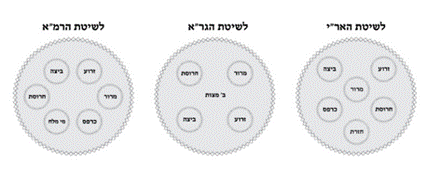
2. The Ke'ara of Leil Haseder that is brought to the table has on it Maror, Karpas, Charoses, Z'roa [a roasted wing of a chicken], and an egg. There are various customs as to when the Ke'ara is brought to the table. Some bring it after Kiddush before eating the Karpas[13], whereas some bring it already before Kiddush[14]. The custom of the Gr"a is to bring it in after Karpas ('the first of the two dippings done at the Seder'[15]).
3. Likewise, there are several customs how to set up the Ke'ara; some set it in a way that the Karpas and the salt water will be close to the one leading the Seder. Behind that are the three Matzos, and further back are the Maror, Charoses, Z'roa and the egg. This is to ensure that one will not pass over a Mitzva[16]. Others place the Z'roa on the right and the egg on the left, and the Maror is put beneath them (closer to the one conducting the Seder) in the middle. Afterwards (closer) the Charoses is put on the right under the Z'roa and the Karpas on the left under the egg. This is the custom of the Arizal[17]. One should follow the custom of one’s father.
Haseiva
4. One should set up the seats so that it will be possible to recline on the left-hand side and lean on cushions and pillow[18].
5. The way of Haseiva (reclining) is to lean one's body to the left side. Also a left-handed person leans on his left side[19].
6. During Haseiva, the chair should be positioned in a way that the backrest is on the left, so that he can lean to the left and rest on the backrest. However, Bedieved one can even lean on a friend[20].
7. A person sitting on a chair that leans with his body in the air to the left, does not fulfil the obligation of Haseiva.
8. Degree of reclining: A slight tilt is sufficient for Haseiva, as long as it is apparent that one is reclining. The Haseiva must be in a way that his hand is not free and cannot be used for other purposes[21].
9. A person who has a painful condition on the left side that prevents him from Haseiva [including the elderly or the sick for whom reclining is difficult] may be exempt from Haseiva[22].
10. One who finds it difficult starting to drink the wine while reclining, may begin to drink without reclining and then continue to drink a Revi'is while on Haseiva.
11. The custom of most Bnei Ashkenaz is that women do not do Haseiva[23]. Sephardic women, however, are obligated to recline [some Bnei Ashkenaz also follow this[24]]. In any case, if a woman forgets to do Haseiva, she does not have to repeat.
12. Women who do not do Haseiva, should be careful to eat and drink (the items requiring Haseiva) while seated.
13. When a Talmid is at his Rebbi, even if not his main Rebbi, he does not recline unless his Rebbi gives him permission[25]. This pertains also to a person who spends the Seder night in the presence of a Gadol Hador, even if he did not learn from him any Torah[26]. A son at his father’s Seder is Meiseiv even if his father is his main Rebbi. This is because it is understood that a father allows his son to do Haseiva[27]. Some contend that even if his father stipulates that he does not allow his son to lean in his presence, it is irrelevant (Batla Daato) and the son is Meiseiv anyway[28].However, others are of the opinion that in such a case, the son should not be Meiseiv[29].
14. Lechatchila one should recline during the whole meal[30]. However, nowadays many are not particular to do so since we are not accustomed to being Meiseiv throughout the year. See below that in some parts of the Seder Haseiva is Me'akev and one is not Yotzei Yedei Chova if he was not then Meiseiv. In those instances, one should repeat the eating or drinking but without reciting a Bracha.
Kadeish
15. One should not recite Kiddush on the Seder Night until Tzeis Hakochavim (nightfall). Indeed, once the time arrives, right after davening Maariv, one should hasten to make Kiddush so that the young children will not fall asleep[31]. Therefore, one should set the table beforehand and prepare everything needed for the Seder in advance, before Yom Tov [such as checking the Matzos, preparing the Seder plate, the utensils, the cushions for Haseiva, and the like].
16. It is customary to give the children nuts and other treats to help them stay alert and not fall asleep[32]. Another reason is so that they should see a difference from the whole year when these types of foods are not generally shared out during the meal, and the change will arouse them to ask Ma Nishtana[33].
17. Before Kiddush, the person leading the Seder should announce 'Kadeish'. The same is done before 'Urchatz' (the first time washing the hands), and so too during each stage of the Seder he should announce, introduce and explain what is now going to be done[34].
18. The Kiddush cup for the person leading the Seder should be filled by another person. This demonstrates freedom and nobility[35]. Some have the custom that also those participating in the Seder do not pour the wine for themselves, rather each person pours for his friend, to act in a way of freedom[36].
19. Lechatchila one should drink from each cup a complete Revi'is (150 cc according to the bigger Shiur, and 86 cc according to the smaller Shiur[37]), particularly for the first and the fourth cup[38]. However, if one drank the majority of a Revi'is (76 cc according to the big Shiur, and 44 cc according to the small Shiur), he is Yotzei Yedei Chova[39].
20. Some say that the above Halacha [that by drinking the majority of a Revi'is one is Yotzei] applies to a cup that holds only a Revi'is. However, if the cup holds more than a Revi'is, one should drink at least the majority of that cup even though it is more than a Revi'is[40]. Some are Machmir to drink the whole cup[41]. It is correct to take these opinions into consideration, therefore if one finds it difficult to drink too much wine, he should use a cup that holds just a Revi'is.
21. Lechatchila, one should drink the majority of the Revi'is in one go[42], or at least in not more than two gulps.If one took longer than four minutes to drink 'most of the Revi'is', he should drink it again.If he drank it within four minutes, but in more than two gulps, then - if he acted as explained below in paragraph 24 and intended that the Bracha covers all his drinking until the second cup - he should drink it again. If he did not have such intention, he should not drink again[43]. [However, regarding the other cups, see below in their respective places (paragraphs 44,70,78).]
22. One should drink all the four cups of wine BeHaseiva.
23. If one forgot to do Haseiva; Bnei Ashkenaz do not drink again, except for the second cup. Bnei Sepharad must drink again at all cups. However, if one had in mind at the beginning of the Seder when reciting Borei Pri Hagefen, that he will drink more wine and the Bracha will exempt them too, then also Bnei Ashkenaz should drink again the first cup if he forgot to recline. Therefore, Lechatchila one should have in mind before reciting the Bracha over the first cup, that it should cover any wine that he may drink until the second cup[44]. See further below paragraph 42, that it is proper for Bnei Ashkenaz to have in mind when reciting the Bracha of Hagofen over the first cup, not to exempt the second cup. However, Bnei Sepharad who do not recite a Bracha over the second cup, should have in mind when reciting Hagofen over the first cup that it also exempts the second cup.
24. Women are also obligated in all the Mitzvos of the Seder.
25. Before the first cup, one should have in mind to fulfil the Mitzva of making Kiddush on Yom Tov[45]. This is in addition to having in mind to fulfil the Mitzva of the first cup of the Arba Kosos, and the Mitzva of Simchas Yom Tov[46], and the Mitzva of Zechiras Yetzias Mitzrayim, see footprint[47].
26. The order of the Kiddush: The Bracha of Borei Pri Hagefen is first recited. This is followed by the Bracha of Kiddush Hayom and Shehecheyanu. Some say, that when saying Shehecheyanu, one should have in mind all the Mitzvos of the night[48]. Some add, that one should also have in mind the Mitzva of Sefiras Ha'omer[49], but it is not customary to do so. Some recite Shehecheyanu when sitting, but according to the Arizal one should keep standing.
27. Women who recited Shehecheyanu at candle lighting, there is a question whether they may respond Amen to the Bracha of Shehecheyanu. In practice, they should respond [especially sincesome hold that the Shehecheyanu is intended for all the Mitzvos of the night]. However, women with no established custom should not recite Shehecheyanu at candle lighting but at Kiddush[50].
28. The after-Bracha of “Al Hagefen” is not recited after drinking the first cup, since the wine is exempted by the Birkas Hamazon. The accepted custom is so even though the time it takes to digest the wine might pass before reaching the second cup. Some contend that if one suspects that he will pass that time span, then he should recite the Bracha Achrona after drinking the first cup[51].
Urchatz
29. One washes one’s hands in the same way as one washes prior to eating bread[52], but without the Bracha of “Al Netilas Yadayim”[53]. If one mistakenly did say the Bracha, he should eat a Kezayis from the Karpas[54].
Karpas
30. For the Mitzva of Karpas there are various customs; some use celery[55], some use radish[56], whilst others use potatoes[57].
31. The Bracha of Borei Pri Ho'adama is recited. One should eat less than a Kezayis from the Karpas, and have in mind to exempt the Maror with this Bracha[58]. It is proper to have in mind to also exempt the Maror of Korech[59].
32. One should ideally not use a fork to dip the Karpas in the salt water rather it should be done with one's hand. The reason for this is that the purpose of washing the hands (רחצה) is in accordance of the Halacha that when eating a wet vegetable, Netilas Yadayim is required. This holds true only when eating the vegetable with one’s hands[60].
33. There is no obligation to be Meiseiv when eating the Karpas, and there are various customs how to be Noheg; Kabbalistically one should not be Meiseiv[61]. Others say that it is an obligation to be Meiseiv[62]. Therefore, some have the custom to eat half the amount BeHaseiva and half without Haseiva, in order to be Yotze all the opinions.
Yachatz
34. We take the middle Matza from the Ke'ara and break it into two[63]. The larger part is set aside for the Afikoman (many have the custom to hide it), and the smaller part is put back in between the other two Matzos on the Ke’ara.
35. The smaller part should also have at least have the amount of a Kezayis, so that the Bracha of 'Al Achilas Matza' could be recited on it.
Maggid
36. Before one starts to say the Haggada, one should have in mind to fulfil the Mitzva D'oraisa of Sipur Yetzias Mitzraim[64].
37. The story of Yetzias Mitzraim: When a grandfather is leading the Seder for his children and grandchildren, it is sufficient that the grandfather relates the story to the participants, since his son [who is the father of his grandson] will be Yotzei following the Halacha of Shomeia Ke'oneh. In addition, since the grandfather tells the story to his grandchildren, there is no further need for the father to tell it again to his children[65]. However, it is preferable that the father should actively tell his children at least some of the Sipur Yetzias Mitzraim.
38. One should raise the Ke'ara with the Matzos inside and start 'Maggid' by saying 'Ha Lachma Anya' etc. until Ma Nishtana[66]. Some have the custom to pick up just the broken Matza[67].
39. After saying 'Ha Lachma Anya', the Ke'ara should be moved to the end of the table so as to promote the young children to ask questions. Some contend that it is sufficient to just cover the Matzos.
40. The second cup of wine is then poured. Although this cup is not drunk until after Magid, nevertheless we pour it now in order to arouse the curiosity of the children which will cause them to ask questions.
41. The Haggada is said B'eima U'veyira (with seriousness and earnestness) therefore one should not recline[68]. One should refrain from eating or drinking during the Haggada, until after the Bracha of 'Ga'al Yisrael'.
42. Regading a Bracha over the second cup; Bnei Sepharad do not recite the Bracha of 'Borei Pri Hagefen', since it was already exempted with the Bracha of "Hagefen" over the first cup[69]. However, Bnei Ashkenaz do recite a Bracha[70]. It is proper therefore, to have in mind when reciting the first Bracha over the first cup, that it should exempt only the כוס ראשון and not the כוס שני, see more in the footnote[71].
43. If while drinking the second cup, he forgot to be Meiseiv, he must drink it again BeHaseiva[72].
44. If he drank the second cup in more than two goes, he should drink it again[73].
Rachtza
45. Before washing Netilas Yadayim for the Matza, if one is certain that his hands are still clean (i.e. he did not touch anything that makes his hands impure) then he should defile his hands by touching something unclean or a covered area of his body. This will certainly enable him according to all opinions to recite the Bracha of 'Al Netilas Yadayim' when washing[74].
Motzie Matza
46. Some write that it is proper to give over ownership of the Matzos to all the people partaking in the Seder (his wife, children, etc.). The accepted custom is not to do so and there are Poskim whom one can rely upon[75].
47. One should have in mind whilst eating the Matza to fulfil the Mitzva of 'Achilas Matza'[76].
48. Holding and breaking the Matzos; the one conducting the Seder should lift the three Matzos [the two whole ones with the broken Matza in between them] and say the Bracha of "HaMotzie". He should then let go of the bottom Matza, and whilst holding just the top Matza and the the broken one, he recitesthe Bracha of "Al Achilas Matza"[77]. One should have in mind that this Bracha is also for the Matzos that one will eat at Korech and Afikoman[78]. A Kezayis is eaten from the top Matza and a second Kezayis from the broken Matza[79].
49. The amount of Matza that one should eat is a total of 30 grams[80]. This way he will have eaten one Kezayis from the 'big Shiur' (30 grams) to fulfill the Din D'oraisa of eating a Kezayis. It is also two Kezeisim from the 'small Shiur' (15 grams) to fulfill the Din D'rabanan that one should eat from both Matzos[81]. (See more extensively in paragraph 79).
50. It is permitted to weigh [with a mechanical scale] the Matza on Shabbos and Yom Tov since there is no prohibition of measuring on Shabbos or Yom Tov for a Mitzva[82].
51. The common custom is to eat the two Kezeisim in less than the amount of time of 'Achilas Pras' without interruption[83], (Lechatchila: 2 minutes, Bedieved: 4 minutes)[84].
52. The custom of Bnei Sepharad is to dip the Matza in salt on the night of Pesach[85]just like on Shabbos and Yom Tov. Bnei Ashkenaz, do not dip the Matza in salt[86]. Nevertheless, salt should be on the table[87].
Maror
53. We take a Kezayis of Maror, i.e. Chrain (horseradish) or lettuce, dip it in the Charoses and then immediately shake it to remove excess Charoses. Even when Pesach falls on Shabbos one may shake off the Charoses, and it is not considered 'Meleches Borer', since this activity does not fully separate all the Charoses.[88]
54. One recites the Bracha of 'Al Achilas Maror', and has in mind to exempt also the Maror that he will eat at Korech.
55. When eating the Maror, one does not recline.
56. The amount of Maror; the leaves of the lettuce weigh slightly less then water so we can estimate their volume by the weight of water. Since the Mitzva of eating the Kezayis of Maror is Miderabanan, one may be lenient to reckon a Kezayis being equivalent to a third of today's egg, which is 17 cc/grams. However, this applies only to someone who is being Yotzei the Bracha on the Maror from someone else. Regarding the person reciting the Bracha himself, the Mishnah Berurah writes that he should eat the 'larger Shiur' of a Kezayis, which is half of today's egg - 50 cc/ grams, which is approximately 2 large lettuce leaves (see below paragraphs 94, 95).
Korech
57. One should take a Kezayis from the third Matza and a Kezayis of Maror. The custom is to place the Maror between the two pieces of the Matza[89]. The amount of Matza needed for Korech is 15 grams[90]. He then dips it in Charoses. People who do not eat 'Gebrokst' should dip only the Maror in the Charoses but not the Matza. We then say 'Zecher Lemikdash Ke'hillel', and eat the Korech[91]. Some say that only after eating the Korech do we say 'Zecher Lemikdash Ke'hillel'[92].
Shulchan Orech
58. After Korech the meal is served. One should eat eggs[93], and be Mehader to eat the egg from the Ke'ara[94] in order to remind us of the Korban Chagiga. The Z'roa should not be eaten, since one does not eat any roasted meat on Seder night.
59. One should be careful not to overeat, so that the Afikoman will be eaten with appetite and not 'Achila Gasa' (which is not considered eating).
Tzafun
60. After finishing the meal, we eat a Kezayis of Matza from the Afikoman[95]. Lechatchila one should eat two Kezeisim of the Afikoman[96] which is all together 30 grams[97]. For children until the age of Bar Mitzva it is sufficient to eat Lechatchila the Shiur of 15 grams.
61. All participants of the Seder should include in their Kezayis a small piece from the 'Matza of the Afikoman', and the remaining amount of a Kezayis can be added from other Matzos.
62. The Afikoman must be eaten BeHaseiva. If he forgot but remembered before Birkas Hamazon, it is correct to eat again BeHaseiva. However, if this is difficult for him, then he can be lenient not to eat again[98].
63. After eating the Afikoman it is prohibited to eat and drink until daybreak anything other than water or tea[99]. If one went to sleep and got up early before daybreak (Alos Ha’shachar), according to the basic Halacha, one is allowed to eat and drink[100].
64. One should make an effort to eat the Afikoman before Chatzos [midnight][101], and if necessary one should rush the meal.
65. If this is very difficult, there are those who are lenient by eating now [before Chatzos] a Kezayis and making the following stipulation: If the Halacha is like ראב"ע that the time of eating the Afikoman is only until Chatzos, then this Matza will be eaten as the Afikoman, and if the Halacha is like ר"ע that the time of eating the Afikoman is until Alos Hashachar, then this Matza is not the Afikomen, rather the Matza that will be eaten at the end of 'Shulchan Aruch' will be eaten to be Yotze Yedei Afikoman[102].
Barech
66. One recites Birkas Hamazon over a cup of wine. The cup should be cleaned and rinsed before bentching[103].
67. Ya'aleh Veyavo is added in Birkas Hamazon as with all the other Yomim Tovim. If one forgot, he needs to bentch again[104]. However, if he remembered only after he already drank from the cup of Birkas Hamazon, he should recite Birkas Hamazon again without a cup[105].
68. The third cup: It is proper for Bnei Ashkenaz to have in mind when reciting the Bracha of Hagofen over the thirth cup, not to exempt the fourth cup.
69. The third cup is drunk BeHaseiva. If one forgot and did not recline, Bnei Sepharad should drink again BeHaseiva, but Bnei Ashkenaz do not drink again so as not to appear as if he is adding to the four cups.
70. If it took longer than four minutes to drink the third cup, one should drink again[106].
Hallel
71. After drinking the cup of Birkas Hamazon, the forth cup is poured and then we say 'שפוך חמתך' etc. Some pour the fourth cup only after saying שפוך חמתך [107].
72. It is customary to open the door of the house before sayingשפוך חמתך.
73. Lechatchila one should say Hallel before Chatzos [midnight][108].
74. We recite from לא לנו'' until the end of the Hallel and then 'Birkas Hashir' is recited over the fourth cup, and after that we drink it. One needs to drink a Revi'is so that he can recite a 'Bracha Achrona'.
75. It is proper to drink the fourth cup before Chatzos [midnight][109].
76. The fourth cup: Bnei Sepharad do not recite 'Bore Pri Hagefen' on the fourth cup, since it was already exempted by the 'Birkas Hagefen' over the third cup. Bnei Ashkenaz do say Borei Pri Hagefen on the fourth cup. It is proper for them to have in mind before the Bracha on the third cup not to exempt the fourth cup.
77. One should be Meiseiv while drinking the fourth cup. If one forgot, Bnei Sephard should drink again BeHaseiva [without repeating the Bracha of HaGofen[110]], but Bnei Ashkenaz do not drink again.
78. If it took longer than four minutes to drink the fourth cup, one should drink again.
Additional Halachos relevant to the Seder night
The proper amount for eating Matza
79. The one conducting the Seder should Lechatchila eat two Kezeisim and the other participants in the Seder must eat one Kezayis.
There is a dispute what is the amount of a Kezayis. The bigger Shiur (55 cc) is equivalent to two Kezeisim of the smaller shiur (27 cc).
Therefore, the one conducting the Seder and all the participants should eat 30 grams of Matza (which is 55 cc). This amount includes one big Kezayis that is equal to two small Kezeisim. [Since the above mentioned Halacha that the one conducting the Seder needs to eat two Kezeisim is Miderabanan, it is sufficient for him to eat the amount of one big Kezayis which includes in it the amount of two small Kezeisim.]
A standard square machine Matza weighs 30 grams, and an average hand Matza weighs about 60 grams. Therefore, half an average hand Matza is 30 grams (keep in mind, some companies provide approx. sixteen Matzos for each kilo, whereas others provide up to 22 Matzos for each kg.).
The same is regarding the Afikoman, where one should eat two Kezeisim, Lechatchila one should eat the equivalent of one whole machine Matza or half of a hand Matza (depending on the size and thickness, as above).
For Korech, 15 grams of Matza is sufficient, which is the equivalent of half a machine Matza or a quarter of a hand Matza. This is the amount Lechatchila.
80. One who has difficulty eating Matza, can be lenient to eat as little as 15 grams both for the first Kezayis of Achilas Matza, and for the Afikoman. So too regarding children under the age of Bar Mitzva; it is sufficient for them to eat the smaller above mentioned amount. Someone who is restricted from eating even this smaller amount, must seek guidance from a Rav regarding less than this amount.
The four cups of wine
81. All types of wine are Kosher for Kiddush and for the Four Cups, including dry wine, semi-dry wine, sweet wine, and Mevushal (cooked wine). See the note regarding which of them is preferable, as well as the Halacha concerning low-alcohol wine[111].
82. It is a Mitzva to use red wine[112].
83. Lechatchila, one should drink intoxicating wine which is as a sign of freedom. For this reason, ideally one should drink wine rather than grape juice. If drinking only wine is difficult, he can mix one-third wine with two-thirds grape juice (or at least one-sixth wine) as long as the taste of wine is discernible. Someone who cannot have wine, can be Yotze Yedei Chova by drinking only grape juice.
84. If wine is not obtainable, 'חמר מדינה' can be used for the four cups. However, the classification of חמר מדינה in our times is unclear. Bedieved we can accept that one is Yotze Yedei Chova with tea, coffee, or coke. Since the whole concept of 'חמר מדינה' in our times is unclear, it is proper to also be Yotzei the 'Arba Kosos' through 'שומע כעונה' as explained below, and one should proceed as follows:
He should listen to the Bracha of Hagofen from another person who is drinking wine or grape juice, answer Amen [intending to fulfill his obligation through שומע כעונה], and afterwards recite Shehakol himself and drink.
85. Since the Bracha on חמר מדינה is Shehakol, one does not recite a Bracha on the second and fourth cup because they are exempted by the first and the third Bracha.
86. One who is diabetic and may not drink any wine or grape juice at all (not even dry wine), can be Yotze Yedei Chova with חמר מדינה and also with "שומע כעונה" as mentioned below.
87. Tosfos in Pesachim (צ"ט:) remains with a question if one is Yotze Yedei Chova of ארבע כוסות with שומע כעונה, similar to Kiddish where the one reciting Kiddush exempts all the others with his Bracha and with drinking the כוס של ברכה. Likewise regarding the ארבע כוסות, it could be that others are Yotze with the Bracha and drinking of the one conducting the Seder. Another important factor is, that the חדושי מרן הגרי"ז הלוי פ"ז מהל' חו"מ explains that the central component of the Mitzva of ארבע כוסות is not drinking the cups, rather the Bracha over the wine.
88. Lechatchila, one should use a cup that holds a Revi'is (150 cc) and each one of the four cups should be drunk entirely.
89. People that are unwell or children who cannot drink this amount, should use a cup that contains 86 cc (A Revi'is according to the smaller amount). If he cannot drink it all, he should drink at least most of a Revi'is which is 44 cc. See more in above paragraph 19.
90. There is a question regarding a person that is sick and can drink only approx. 86 cc, should he use a large cup that holds 150 cc and drink most of it, or should he use a cup that holds 86 cc and drink it all.
Lehalacha, it is preferable that he should use a cup that holds 150 cc and drink most of it (76 cc).
The Din of eating Matza for someone who is ill
91. A healthy person may crumble the Matza into fine crumbs and eat them, or dip the Matza in water without actually soaking it [providing that he does not have the Minhag to avoid Sheruya] or drink some water while swallowing the Matza.
92. A person that is ill can soak the Matza in water until it softens and then eat it, as long as it does not get dissolved.
93. If one ate Matza or Maror and then vomited, he is nevertheless Yotze Yedei Chova. However, if he vomited all that he ate without even a Kezayis being left in his stomach, he should not recite a Bracha Achrona [on the Matza].
The amount of the Maror
94. Lettuce is close to the weight of water. Therefore, when reciting Al Achilas Maror, the one reciting the Bracha should eat 50 grams of lettuce [and some say that 27 grams suffices]. Those who were Yotzei by listening to the Bracha need only 17 grams of lettuce. For eating Korech, 17 grams suffices both for the one who recites the blessing and for the participants (See above paragraph 56).
95. Horseradish (Chrein) is also equal to the weight of water, therefore the person reciting the Bracha should eat 50 grams [some hold that 27 gr. suffices] for Maror, and for Korech 17 grams. For the participants 17 grams suffices for both Maror and Korech.
[1] As brought in the Rema (O.C. 451:4), that the stove grate must undergo Libun (heated until it becomes red-hot). However, this ruling is not mentioned in the Shulchan Aruch, and therefore some Bnei Sepharad are more lenient regarding the Kashering of the grates. See also Mor U’Ketziah (ibid.), who questions the Rema and writes that even according to the stringent opinion, Hagalah (purging with boiling water) is sufficient. [Indeed, some Bnei Sepharad have the custom to Kasher the grates by Hagalah.] The Ma'amar Mordechai (ibid.), likewise questions the Rema, but concludes that because of the stringency regarding Chametz one should be stringent like the Rema.
Therefore, some Bnei Sepharad are careful to perform Libun on the grates as well—especially since it is very difficult to clean them thoroughly. It would appear, however, that if one wraps the grates and the surface with thick aluminum foil, there is no need for Libun even Lechatchilah.
[2] The reason that the grates need Libun and not Hagalah is since it absorbed Chametz through the use of direct fire and not through the use of liquids, therefore Hagalah is insufficient.
The level of Libun needed: The Mishnah Berurah writes (סימן תנ"א ס"ק ל"ד) that Libun Kal is sufficient, which is at most 250 degrees Celsius. This would enable Kashering the grates after cleaning them, by placing them in the oven and turning it on the highest heat level for one hour. However, some contend that since the actual fire does not touch all areas of the grates, they need Libun Chamur which is approximately 500 degrees Celsius. According to this there would be no way to be Machshir the grates in a regular oven, only in a self-cleaning oven that reaches 500 degrees Celsius. Another reason to require 'Libun Chamur' is that regular grates are coated with enamel and it is unclear whether Libun Kal can Kasher them, see Mishnah Berurah סי' תנ"א Sha'ar HaTziun ס"ק קצ"א.
Some hold that Libun could be done by placing a sheet of metal or tin on the entire stovetop, covering all the burners and then turning on all the flames at the same time.
[3] Wherever it specifies that thick aluminum foil is required—this means a thickness of 50 microns. At minimum, two layers of thin aluminum foil should be used.
The general rule is that the area must remain covered, and items should not come into direct contact with it.
[4] According to the Rama (סימן תנ"א סעי' כ"ו) Kashering cannot be done on glass dishes, and according the Shulchan Aruch one may use them without Kashering them. In the above mentioned case, some hold that even according to the Shulchan Aruch one should refrain from using it, since some hold that since it is not made of regular glass [but of Duralex or Pyrex], it is therefore considered earthenware that cannot be Kashered. Yet many are lenient according to the Shulchan Aruch to use them without Kashering after thoroughly cleaning them.
[5] If one finds it difficult to reach all the folds and crevices of the gaskets, he should spray some strong cleaning agent on them. This will ensure that even if there are still some crumbs inside, they will become unpalatable which in turn do not require Bi'ur. However, one cannot forgo on the cleaning process by just spoiling the crumbs and making them unpalatable, since there is the possibility that a crumb may fall into his food, and it is not absolutely clear that the crumb is inedible even for a dog.
[6] Some spray a cleaning agent in the drainage pipe that spoils any remnants of edible Chametz food, but according to Halacha it is not necessary.
[7] Many Bnei Sepharad are lenient to use the sink itself, since its primary use is with cold water (רוב תשמישו בצונן). Some perform Hagalah by pouring boiling water over it three times (Iruy three times), in which case one may combine this with the opinions that hold that three Hagalahs are effective for earthenware vessels. Even for Bnei Ashkenaz, in a pressing situation one may be lenient in this regard, based on what is explained in Sha'ar HaTziyun (O.C. 451:51) since an earthenware sink cannot practically be Kashered by regular Hagalah, one relies on the principle that its primary use is with cold water.
[8] There is an argument between the Shulchan Aruch and the Rama (סימן תנ"א סעיף ו') regarding a utensil that most of its usage is in a Kli Sheini or by Irui MiKli Rishon, and only occasionally it is used in a Kli Rishon. The Shulchan Aruch holds that its main way of being used is the deciding factor and therefore it does not require Hagalah in a Kli Rishon. [Accordingly, even regarding a countertop and a sink, since their primary use is with cold water (רוב תשמישו בצונן), they do not require Kashering. However, it is proper to be stringent and perform Hagalah, as explained in the main Halacha.]
However, the Rama is of the opinion that it must be Kashered in a Kli Rishon since it was also used in that manner albeit only occasionally.
[9] There are three types of marble counters commonly used in Eretz Yisrael: 'Chevron', granite and caesarian marble. 'Chevron' has the Din of stone and can be Kashered. Regarding Granite, Hagalah could essentially be done on it, but some hold that Hagalah cannot be done on it, since the owner would be afraid that it could get damaged due to the heat, and the Din is that something that the owner is afraid that might get damaged because of heat 'he may have pity on it' and not do the Hagalah properly, therefore Hagalah cannot be done altogether. Nevertheless, Lehalacha, we allow Hagalah on this type of marble (without an 'Even Milubenes'). The reason is that since the heat is only for a very short time, no damage will be done and we do not need to worry that the Hagalah will not be done properly. Regarding Caesarean marble, according to the Chazon Ish and the Yad Yehudah Hagalah cannot be done on it.
[10] Since some hold that it is not appropriate to mention a fast in public during the month of Nissan, one should avoid doing so. However, if it has already been appointed and there are ten people who are fasting, it may be said in the She’ma Koleinu of the Amidah, following the law of a private fast (משנ"ב סי' ת"ע סק"ב).
[11]The Sha’arei Tziyun on Hilchos Pesach (סי' תמ"ד סק"א, סי' תע"א סק"כ) cites the dispute among the Acharonim but does not render a final ruling. However, on Hilchos Seudah Shlishis (סי' רצ"א ס"ק כ"ה) he rules that it is permitted. This is also the opinion of the Gra”z (סי' תע"א ס"ט) and the Chayei Adam (כלל קכ"ט סי"ג).
[12] עיין מהר"ם שיק (או"ח סימן כ"ח) ובקצה המטה על מטה אפרים (סימן תר"י ס"ק ט"ו), ויגד משה (סי' י"ב)
[13] רמב"ם (חמץ ומצה פ"ח ה"א) ושלחן ערוך (סימן תע"ג ס"ד)
[14] אבודרהם, פרי מגדים (סימן תפ"ו מש"ז סק"א)
[15] מעשה רב (אות קצ"א)
[16] רמ"א (סימן תע"ג ס"ד)
[17] - חיי אדם (כלל קל ס"א) משנה ברורה (שם ס"ק כ"ו) וראה בחק יעקב (שם ס"ק ט"ז)to see an explanation why there is no problem of passing over a Mitzva.
[18] גמרא (פסחים צ"ט ע"ב) שלחן ערוך (סימן תע"ב ס"ב) ומשנ"ב (שם סק"ז)
[19] שו"ע ורמ"א (שם ס"ג) A right-handed person who reclines on the right side is considered not to have reclined [his Halachic status is explained below in the following paragraphs]. A left-handed person who reclined on the right side fulfills the obligation.
[20] מגן אברהם (שם סק"ג) משנ"ב (שם סק"ח)
[21] A proof for this is in פסחים ק"ח in the רשב"ם ד"ה הסיבת ימין, and מ"ב תע"ב ס"ק י'
[22] עי' ביה"ל (שם ס"ג) וכה"ח (שם ס"ק כ"ב)
[23]שולחן ערוך ורמ"א (שם ס"ד)
[24]פסח מעובין (סימן ק"ע), בן איש חי (פרשת צו אות כ"ח), ומנהגי חת"ם סופר.
[25] שלחן ערוך (שם ס"ה), משנה ברורה (ס"ק יז)
[26] מקור חיים (סימן תע"ב סק"ה)
[27] כל בו (סימן מ"ח), אבודרהם ולבוש (שם ס"ה)
[28] חק יעקב (שם סק"ט)
[29] פרי מגדים (שם מש"ז סק"ד)
[30] רמב"ם (חמץ ומצה פ"ז ה"ה)
[31]שו"ע (סי' תע"ב ס"א) בט"ז (שם סק"א) ובמשנ"ב (שם סק"ה)
[32] גמ' פסחים קח ע"ב, שלחן ערוך (סימן תע"ב סע' ט"ז) ובמש"נ (שם סק"ה)
[33] The רמב"ם (חמץ ומצה פ"ז ה"ג) counts giving nuts and the like as one of the changes we do to promote the children to ask. The מאירי בפסחים ק"ח ע"ב explains this as all being one reason.
[34] יסוד ושורש העבודה (שער התשיעי פרק ו'), סידור בית יעקב ליעב"ץ
[35] רמ"א (תע"ג ס"א)
[36] ויגד משה (סי' ו') עפ"י לשון הקיצור שו"ע (סי' קי"ט סק"ב), ועי' לשון יוסף אומץ (אות תשנ"ג)
[37]For the first cup which is theכוס of Kiddush one needs to be stringent to drink the larger amount since the הכרעת המשנה ברורה (סימן תפ"ו סק"א), that regarding Dinim of D'oraisa one should drink the large Shiur of the נודע ביהודה and the Mitzva of Kiddush is D'oraisa as it is brought in the גמרא (ברכות כ' ע"ב), and we find in several Poskim [אור זרוע הלכות ערב שבת אות כ"ה, מגן אברהם סימן תקצ"ז סק"ג בשם המהר"ם] that also Kiddush on the wine is דאורייתא. Although, below in footnote 43 it is brought that Kiddush on Yom Tov is מדרבנן, but some are of the opinion that on the night of Pesach it's Min HaTorah. עי' מדרש שכל טוב]. Therefore, one should be stringent and use a cup holding 150 cc for the first כוס.
[38] Regarding the first cup, the reason is that Kiddush must be followed by the Se'udah. On the night of the Seder, the meal will be eaten only a long time after Kiddush, but if one drinks the entire Revi'is one fulfills the Din of קדוש במקום סעודה. This follows the ruling of the שלחן ערוך in סימן רעג' ס"ה in the name of the Ge'onim that drinking a Revi'is of wine at Kiddush is considered a Se'uda regarding this Din. The reason why a Revi'is should be drunk at the fourth cup is that since one recites a Bracha Achrona after drinking this cup, it should contain a Revi'is, as explained in the ט"ז סימן תפ"ו סק"א.
[39] A person whose mouth is large, so that his Melo Lugmov contains more than the amount of Rov Revi'is, is required to drink the amount of his own measure of Melo Lugmov. [שו"ע (סי' רע"א ס"ק י"ג) משנ"ב שם (ס"ק ס"ח) ןביה"ל (סי' תע"ב ד"ה וישתה)]
[40] שלחן ערוך (סימן תעב ס"ט) and in the משנה ברורה (ס"ק ל"ג) that it is proper to take this opinion in to consideration.
[41] ב"ח and גר"ז (סעיף י"ט) bring this opinion.
[42]מ"א (תע"ב ס"ק י"א) and גר"ז (there(סע' כ' and in the משנ"ב (there .(ס"ק יא'
[43]משנה ברורה (סימן תעב' ס"ק ל"ד)
[44]שלחן ערוך (סימן תעב' ס"ז) ruled like the רא"ש פסחים פ"י סימן א')) that anything that needs Haseiva, if one ate or drank without Haseiva he was not Yotze Yedei Chova. Therefore, if any of the four cups were drunk without Haseiva, he must drink them again with Haseiva. The Rama rules that just by the first two cups one must drink again BeHaseiva, whereas regarding the last two he should not drink them again BeHaseiva, because there he must recite a new Bracha of Hagofen in order to drink them and it would appear that he is adding on to the four cups of wine. In such a scenario one can therefore rely on the ראבי"ה who rules that since nowadays it is not usual to be Meiseiv, there is no obligation to do so. The מגן אברהם writes (ibid(סק"ז that according to the custom that even between the first two cups we do not drink, and if one does drink he will require a new Bracha on the wine (since he didn't have Kavana when reciting the first Bracha to exempt it), and making a new Bracha will make it seem that he is being מוסיף על הכוסות, therefore one should not drink again even regarding the first two cups. However, the פרי מגדים writes that if Kiddush was made over a large cup that holds the amount of two Revi'iyos, then if a Revi'is is left in the cup one can drink that which remains in the cup whilst reclining. Likewise, whoever had כונה to drink more wine between the two first cups and forgot to recline, can drink again whilst reclining.
[45] Kiddush on Yom Tov over wine is just מדרבנן, see מגיד משנה ((שבת פכ"ט and מגן אברהם (סימן רע"א).
[46] Some say that it is מדרבנן and some say it is מן התורה, see פסחים ע"א וק"ח ע"ב and the מג"א סימן תקמ"ו andשו"ת שאגת אריה סימן ס"ח .
[47] He fulfills the obligation by saying "Zecher Leytzias Mitzrayim" as explained by Rabeinu Yerucham (נתיב ה' ח"ד, בשם רבינו פרץ) and by the Pri Chadash (סוס"י תע"ג) . It was also transmitted in the name of Chaim Soloveitchik that in the words "Zman Cheiruteinu" one fulfills the Mitzvah by mentioning that this day is the day on which the Jews left Mitzrayim.
[48] Seeאבודרהם and ברכי יוסף סי' תע"ג and the יעב"ץ in his Sidur.
[49] Seeמאירי (פסחים דף ז') , שבולי הלקט (סי' רל"ד) , and .אבודרהם
[50] משנ"ב (סי' רס"ג ס"ק כ"ג)
[51] According to the מהר"ח אור זרוע סימן רע"ג , see also אשל אברהם (בוטאשט, סימן תע"ד)
[52] The relevant Dinim regarding the ,כלי how much of the hand must be washed, as well as the prohibition of הפסק and היסח הדעת are all explained in the שלחן ערוך (סימן קנ"ח ס"ז) and in the.משנה ברורה (שם סק"כ)
[53] ,שלחן ערוך (שם ס"ד) According to the G'ra one makes a Bracha on this Netila, but this is only if he eats a Kezayis of the Karpas.
[54] As brought down in the note above, according to the G'ra one makes a Bracha on something which is טיבולו במשקה, only if he eats a Kezayis. Therefore, if by mistake one made a Bracha on this Netilah, he should eat a Kezayis thereby being Yotzei the opinion of the G'ra, and that way it won't be a ברכה לבטלה.
[55] מחצית השקל (סימן תע"ג) and the .חת"ם סופר (שו"ת סימן קל"ב)
[56] קיצור שו"ע (סימן קי"ח)
[57] ערוך השלחן (סימן תע"ג) and so was the Chafetz Chaim's custom.
[58] משנ"ב (תע"ג ס"ק נה)
[59] סידור יעב"ץ
[60] ע"פ או"ח (קנ"ח)
[61] שבלי הלקט (סימן רי"ח) and.ברכי יוסף (סימן תע"ג)
[62] .אבודרהם (פרוש על ההגדה), קיצור שו"ע (סי' קי"ט ג'), מאמ"ר
[63] Since the Matza is לחם עוני, and the way of poor people who cannot afford a whole loaf is to eat pieces of bread.
[64]See משנ"ב (ס' תע"ג ס"ק א) that Mitzvos need Kavana as is ruled in the (סימן ס' ס"ד) שלחן ערוך, and especially Mitzvosדאורייתא , see אליה רבא (סימן תפ"ט ס"ק י"ב) and additional Poskim.
[65] פסחים קט"ז, שו"ע הגר"ז (תע"ג, כ"ד), מעשה רב
[66] שלחן ערוך (סימן תע"ג ס"ו), מגן אברהם (שם ס"ק כ"ג), ומשנה ברורה (שם ס"ק ס')
[67] חק יעקב (סימן תע"ג ס"ק ל"א) in the name of פסח מעובין, in order not to seem like he is מקדיש הזרוע המוגבהת when lifting the Ke'ara.
[68] של"ה (פסחים ב.), חק יעקב (סימן תע"ה ס"ק י"ד), ופרי מגדים (מש"ז סימן תפ"ו), משנ"ב (סי תע"ג ס"ק ע"א).
[69] שלחן ערוך (סימן תע"ד ס"א) . Bnei Sepharad should have in mind before saying Hagofen over the first cup to exempt the second cup.
[70]רמ"א there, מגן אברהם and ט"ז there .סק"א
[71] פרי מגדים (מש"ז שם), the reason being so that he should require a Bracha on the second cup according to all opinions. On the other hand, we find that the Mishnah Berurah (שם ס"ק כ"א) writes that before making the Bracha on the first cup one should have in mind to continue drinking more wine in case he forgets to do Haseiva, allowing him to drink another cup of wine without having to make another Bracha and it will not appear to being adding more cups. Therefore, it is advisable to do as the Pri Megadim says and have in mind to exempt all the wine just until the second cup but at the same time specifically to have in mind not to exempt the second cup. This solution will on the one hand enable him to drink Behaseiva without reciting a Bracha if he forgot to recline whilst drinking the first cup, and on the other hand he will be able to recite another Bracha on the second cup according to everyone (since it was not exempted by the first Bracha).
[72] For Bnei Sepharad this is obvious as explained earlier in paragraph 23. Regarding Bnei Ashkenaz, the Mishnah Berurah writes (סימן תע"ב ס"ק כ"א) that since we do not make a Bracha on wine that is brought during a Se'uda, as the Bracha on the second cup exempts all wine which is part of the Se'uda, therefore one can drink the second cup again, without any problem of seeming adding on another cup of wine. Indeed, there is an indication in the Sha'ar Hatziyun (אות ל"א) that where one does not have in mind to drink more wine during the Se'uda he must make another Bracha, therefore one should have in mind to exempt all wine that he will drink during the Se'uda.
[73] .משנה ברורה (סימן תע"ב ס"ק ל"ד)
[74] .פרי מגדים (סימן תע"ג מש"ז סק"א) וביאור הלכה (תע"ה)
[75] .שפת אמת (סוכה ל"ה ע"א), אמרי בינה (או"ח פסח סימן כ"ג)
[76] As explained in Shulchan Aruch (סימן ס' ס"ד) that the Halacha is that 'Mitzvos Tzrichos Kavanah', indeed the Shulchan Aruch (סימן תע"ה ס"ד) rules like the Rambam (חמץ ומצה פ"ו ה"ג) that where one ate Matza without Kavana he fulfilled his obligation. The Mishnah Berurah explains that this follows that which the Magid Mishnah brings from the Ran in Mesechta Rosh Hashana that Mitzvos that are done by eating, having the Mitzva in mind is not Me'akeiv, since there is enjoyment and enjoyment is equal to Kavana. Nevertheless, the Mishnah Berurah brings the opinion of the Rosh (ר"ה פ"ג) that even Mitzvos done through eating necessitates Kavana, and one must take this opinion into account. This is all Bedieved but Lechatchila according to everyone one should have Kavana even for a Mitzva done by eating.
[77] .שו"ע (סימן תע"ה ס"א) ומשנה ברורה (סק"ג)
[78] .פרי חדש (שם סק"א)
[79] .שולחן ערוך (שם) ומשנה ברורה (סק"ט)
[80] Which is approximately 55 c"c.
[81] Shulchan Aruch (סימן תפ"ו ס"א) and Mishnah Berurah (שם סק"א). One who has difficulty eating this Shiur of Matza, could be lenient to eat less, after consulting a Rav. Regarding children under the age of Bar Mitzva, one can be lenient Lechatchila to eat 15 grams.
[82] Since there is no difference between measuring and weighing.
[83] עי' או"ח (סימן תע"ה)
[84] There are some who are more lenient. Someone who is unwell etc. should ask a Rav, being that some contend that we can assume that the Shiurim got smaller, so in the same vein, the time of 'Achilas Pras' doubled as well.
[85] .טור (סימן תע"ה בשם הירושלמי), שולחן ערוך (שם סק"א), ובאר היטב (סק"ג) מדברי האר"י בזה
[86] .רמ"א (שם), ומקןרן מלקט יושר (ח"י) בשם מהרי"ל
[87] .עי' ברכות (דף מ) בתוספות שם , ואו"ח סי' קס"ז
[88] This is similar to the case mentioned in the Taz (סימן שי"ט ס"ק י"ג), and the Mishnah Berurah (שם ס"ק ס"א) that it is permitted to remove a fly from a drink when it is removed with some liquid, since Borer is only when just the unwanted item is removed. So to, since even after shaking the Charoses from the Maror there remains some Charoses on the Maror, the Melacha of Borer was not committed.
[89] קיצור שולחן ערוך (סימן קי"ט ס"ז), ערוך השולחן (סימן תע"ה ס"ו)
[90] Since regarding Mitzvos Derabanan we rely on the smaller Shiur. משנה ברורה סימן תפ"ו סק"א.
[91] This is the simple reading of the Shulchan Aruch (סימן תע"ה ס"א), שלחן ערוך הגר"ז (שם סי"ח), קיצור שלחן ערוך (סימן קי"ט ס"ז).
[92] Bi'ur Halacha (שם ד"ה ואומר), this is to negate the problem of Hefsek between the Bracha on the Maror and eating the Korech.
[93]רמ"א (סימן תע"ו ס"ב), וראה חק יעקב (שם סק"ו) בטעמים לכך ,the difference regarding Yom Tov Sheini.
[94] - (משנ"ב תע"ו ס"ק י"א) There are some that do not eat the egg that is on the Ke'ara so that the Ke'ara remains complete until the end of the Seder (מאמ"ר סי' תע"ג סק"ח).
[95] שולחן ערוך (סימן תע"ז ס"א) which is 15 grams.
[96] מגן אברהם (שם סק"א), ומשנה ברורה (שם סק"א)
[97] One who finds it difficult, could eat the Shiur of 15 grams, and one who is unwell may even be allowed to eat less. A Rav should be consulted.
[98] משנה ברורה סימן תע"ז סק"ד. Regarding that which is written in סימן תע"ב ס"ק כ"ב we can say that it is only referring to one who remembered after Birkas Hamazon, and in this instance the Afikomen is regarded as eating it two separate times, as the simple indication there. Whereas before the Bracha was said and he is considered to be still in the Se'uda, then the Afikomen is considered as one long continuation.
[99]שולחן ערוך (סימן תע"ח ס"א) ומשנה ברורה (שם סק"ב)
[100] ,חוק יעקב (סימן תפ"א סק"א) ופרי מגדים (שם אש"א סק"א) Nevertheless, following the Zohar, after sleeping even before daybreak one should not eat. This is quoted in the Mishnah Berurah (סימן פ"ט).
[101]שולחן ערוך שם
[102] אבני נזר (סימן שפ"א), following that which he explains that according to the opinion of R' Eliezer the prohibition to eat after the Afikomen to ensure that its taste remains in his mouth, is only relevant until midnight (which is the time until when one can eat the Afikomen). There are many Poskim who are skeptical about this Chidush, as well as questioning if such a stipulation would work. Therefore, it is optimal to eat the Afikomen before Chatzos.
[103]פרי מגדים (מש"ז סימן תפ"ו), משנה ברורה (סימן תע"ט סק"א) .
[104] שו"ע (סימן קפ"ח סעיף ו'), משנה ברורה (שם ס"ק ט"ז) ,even women have to bentch again .עי' רעק"א (שו"ת סימן א')
[105] Since one must not add on to the four cups of wine, and even a Bracha that was made over the wine after having omitted Retzei or Ya'aleh Veyavo in bentching is still considered a Bracha, as seen in סימן קפ"ח סעיף ט' [dependent on the opinions in סימן ק"ח סי"א], and in any case he fulfilled his obligation of drinking the third cup as part of the Seder after the first Birkas Hamozon.
[106]משנה ברורה (סימן תע"ב ס"ק ל"ד)
[107] ויגד משה (סימן ל')
[108] תוספות ור"ן (מגילה כ"א ע"א), רמ"א (סימן תע"ז) see next footnote.
[109] ביאור הגר"א (סימן תע"ז אות ו') explaining the reason of the Rama that one must say Hallel before Chatzos. Indeed, in the Ma'ase Rav it is brought that in practice the G'ra was lenient regarding this, and he finished Hallel after Chatzos.
[110]שו"ע (סי' ת"פ), רעק"א (שם)
[111]If the taste of all the above wines is equal and equally pleasing to him, one should take into account the opinion of the Ranbam and those who agree with him that Kiddush should not be recited over wine containing added sugar, as well as the views among the Rishonim that Kiddush should not be recited over cooked wine (סי' ער"ב ס"ק כ"ג, סי' תע"ב ס"ק ל"ט).
Accordingly, preference should be given to dry red wine that is not cooked, since semi-dry and sweet wines often have sugar added. Although even dry wine may contain certain additives - and it may be discussed whether this poses a problem according to the above view of the Rambam - nevertheless it is preferable, since those substances are secondary; this matter still requires further consideration. However, if semi-dry or sweet wine is more pleasing to him, he should drink the wine he prefers.
Pasteurized wine is not considered cooked wine.
Low-alcohol wine and “light” wine: It is preferable to drink grape juice mixed with wine rather than low-alcohol or light wine, because such wines are often a mixture of wine, grape juice, and water. Their low alcohol content is therefore frequently due not to halting the fermentation process before the alcohol becomes strong - in which case one could argue that if the strength of the wine is noticeable it would have the status of wine, and if it is not noticeable it would have the status of grape juice (this too requires further analysis) - but rather due to dilution with water; therefore they are less preferable.
Sparkling wine: It may be used even Lechatchilah; however, sparkling wine is often low in alcohol, and is therefore less preferable, as noted above.
[112] It is preferable to use wine that is naturally red. If one drinks white wine on the Seder Night, he should mix red wine into the white wine, and this should be done before Yom Tov, since because he desires the red color there may be a concern of Isur Tzove'a (coloring), even if he reverses the usual order of pouring.